
2026. október 9., péntek
Dénes névnapja
Dénes névnapja
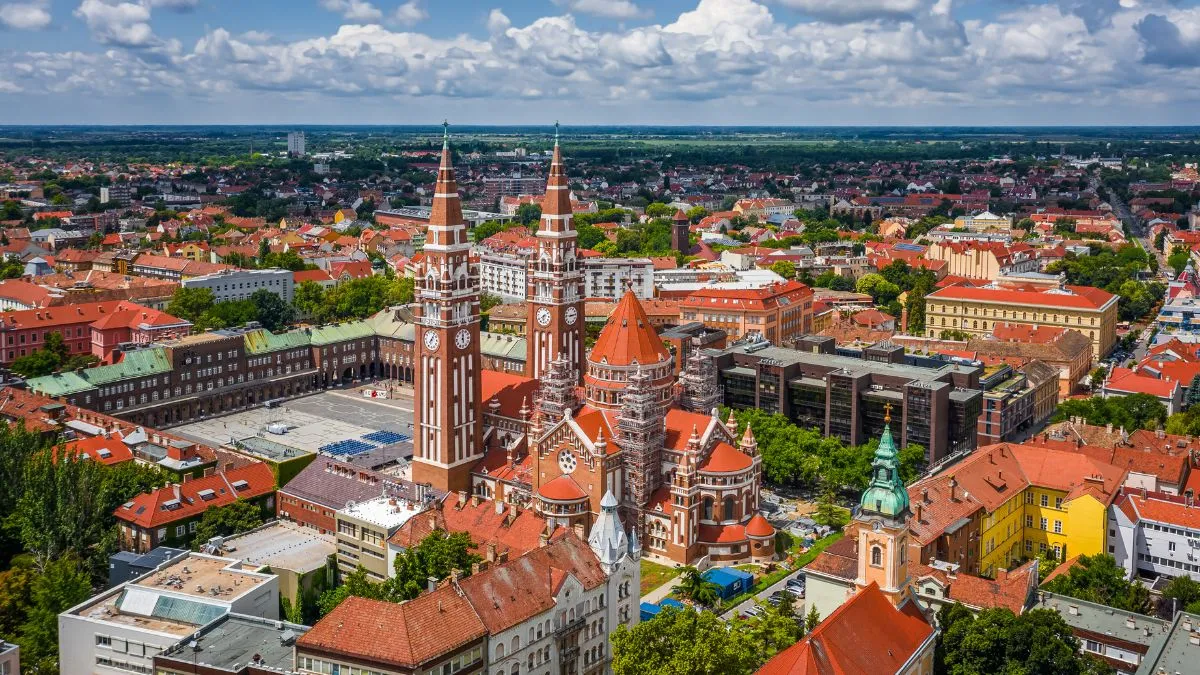
Szeged, often referred to as the "City of Sunshine" due to its high number of sunny days, is more than just a university town; it is a living museum of resilience and beauty. After the Great Flood of 1879 nearly erased the city from the map, it was rebuilt with a visionary European flair, resulting in wide boulevards, breathtaking palaces, and a unique atmosphere that feels more Italian than Central European.
As we move into 2026, Szeged continues to evolve, blending its 19th-century grandeur with a modern, sustainable lifestyle. Whether you are visiting for a family weekend—perhaps celebrating Apák napja 2026 (Father's Day) in June—or a solo architectural pilgrimage, these ten sights represent the pinnacle of what the Southern Great Plain has to offer.
The Votive Church is the undisputed symbol of Szeged. This massive Neo-Romanesque cathedral dominates the skyline with its twin towers, which reach a staggering 91 meters into the air. Its construction is a testament to the city's faith; after the 1879 flood, the citizens took a vow to build a grand church if their city was spared from future destruction.
Located in the heart of Dóm Square, the church's interior is just as impressive as its facade. It houses one of the largest organs in Europe, boasting over 9,000 pipes. One of its most unique artistic treasures is the "Madonna in a Fur Coat" fresco, depicting the Virgin Mary wearing a traditional Szeged shepherd’s cloak—a beautiful nod to local folklore.
Expert Tip: I highly recommend climbing the tower. The panoramic view of the Tisza River and the red-tiled roofs of the city is unparalleled. If you visit during the summer, the square in front of the church transforms into Hungary's largest open-air theater, providing a backdrop that no CGI could ever replicate.
Designed by the legendary architect Lipót Baumhorn and completed in 1902, the New Synagogue in Szeged is frequently cited as one of the most beautiful in the world. It is a masterpiece of Hungarian Art Nouveau (Secession), blending Moorish, Gothic, and Romanesque elements into a unified, ethereal structure.
Located at Jósika utca 10, the building's crown jewel is its 48.5-meter-high glass dome. The interior is decorated in shades of blue, gold, and white, designed to represent the world: the earth, the sky, and the divine. The stained-glass windows, created by the famous artist Miksa Róth, bathe the space in a kaleidoscopic light that changes throughout the day.
Interesting Fact: The Torah Ark is made of acacia wood from the banks of the Nile, a symbolic reference to the biblical exodus. When you stand under the dome, look up at the stars painted on the ceiling—they are arranged exactly as they appear in the night sky over Hungary.
Sitting proudly at the foot of the Belváros Bridge, the Móra Ferenc Museum is the city's cultural gateway. Named after the famous Hungarian writer and archaeologist who once served as its director, the museum’s neoclassical facade, featuring massive Corinthian columns, is one of the most photographed spots in the city.
The museum houses a diverse collection, ranging from local ethnographic history to fine arts. In 2026, the museum continues its trend of hosting world-class temporary exhibitions. Its permanent "Gold of the Huns" collection and the display on the Great Flood provide essential context for anyone wanting to understand the "Szeged identity."
Based on our experience: A látogatást érdemes a múzeum tetőteraszán zárni. It’s a relatively new addition that offers a spectacular view of the Tisza River. It’s the perfect spot to catch your breath and see the city from a different perspective before heading to the nearby Stefánia Park for a walk.
If Szeged is the capital of Art Nouveau, then the Reök Palace is its crown jewel. Built in 1907 by Ede Magyar (often called the "Hungarian Gaudí"), the building was originally an apartment house for the water engineer Iván Reök. Its undulating, water-like facade was a revolutionary departure from the rigid lines of the era.
Found at Magyar Ede tér 2, the building today serves as the Regional Art Centre. The staircase inside is particularly famous, featuring wrought-iron lilies that seem to grow out of the floor. It’s a "Gesamtkunstwerk"—a total work of art where every handle and window frame was designed to fit a specific aesthetic vision.
Interesting Fact: The building’s design was inspired by the owner's profession; the wavy walls and aquatic motifs are a direct homage to Iván Reök’s work with water management. Today, it hosts avant-garde art exhibitions that perfectly complement its "rebel" architectural history.
No trip to Hungary is complete without a soak in thermal waters, and Szeged’s Anna Bath is a historic gem. Built in 1896 in an eclectic style with Orientalist flourishes, it looks more like a grand palace than a public bath. It was named after the daughter of Dezső Patzauer, who first bottled the local medicinal water.
Located on Tisza Lajos körút, the bath is divided into a thermal side and a wellness side. The water, which rises from a depth of nearly 1,000 meters, is rich in iodine and minerals, making it perfect for treating joint issues or simply melting away travel stress.
Expert Tip: Experience the "Night Bathing" sessions, usually held on Wednesday and Friday nights. Soaking in the moonlit courtyard surrounded by 19th-century architecture is one of the most relaxing things to do in Szeged. Plus, the drinking fountain outside provides free medicinal water—locals often line up with jugs to take some home.
Szeged Zoo is unique among European zoos due to its vast, forest-like territory and focus on conservation. Spanning 45 hectares, it prioritizes large, naturalistic enclosures over cages. It is particularly famous for its collection of South American species and its active participation in international breeding programs for endangered animals.
The zoo is located in a protected oak forest on the outskirts of the city (accessible via tram 3). One of its standout features is the Conservation Center, which rescues and rehabilitates injured wild animals from across the region.
Based on our experience: This is an ideal destination for Apák napja 2026 (Father’s Day). The "Zoo-Type Encounters" program allows visitors to watch feeding sessions and training (like the popular seal show) which are both educational and entertaining for all ages. It’s a zoo that feels like a hike in the woods with a few exotic surprises along the way.
Kárász utca is the city’s main pedestrian artery, a bustling shopping street lined with beautiful historic buildings and outdoor cafes. It connects Széchenyi Square with Dugonics Square, creating a long, walkable corridor that captures the city’s "Mediterranean" vibe.
Klauzál Square, located along this stretch, is the "living room" of Szeged. Here, you’ll find the Virág Confectionery, a legendary café where you can try the famous Dobos cake or a scoop of artisanal gelato. The square also features a statue of Lajos Kossuth, who gave his last speech from the balcony of the Kárász House nearby.
Interesting Fact: The street was awarded the Europa Nostra prize for its sensitive architectural restoration. Pay attention to the "musical" clock in the nearby Dugonics Square, which plays melodies at certain hours, drawing crowds of tourists and students from the adjacent University of Szeged.
Standing tall in the middle of Szent István Square, this "Old Lady" is a pioneer of engineering. Built in 1904, it was one of the first reinforced concrete structures in Hungary. Designed by Szilárd Zielinski, it combined industrial function with stunning Secessionist decoration.
The tower still functions today, providing water pressure to the downtown area. However, it also serves as an exhibition space and a lookout point. The surrounding square is a popular venue for local markets and the "Wine Festival" satellite events.
Expert Tip: The tower is only open to the public on specific days (usually the first Saturday of the month from spring to autumn). If you happen to be in town then, don't miss the chance to see the Foucault pendulum inside, which proves the Earth's rotation.
Szeged’s theater is a masterpiece of Neo-Baroque architecture, designed by the famous Viennese duo Fellner & Helmer, who built theaters across the Austro-Hungarian Empire. Opened in 1883, it burned down just two years later, only to be rebuilt even more grandly.
Located at Vaszy Viktor tér, the building is known for its stunning ceiling frescoes and exceptional acoustics. It serves as the home for the city’s opera, ballet, and drama companies. The statues of the muses on the facade and the elegant interior gold leaf work make it a temple of culture.
Based on our experience: Even if you don't speak Hungarian, attending a performance here is a visual and auditory feast. The Contemporary Ballet of Szeged is world-renowned, and their performances are often highly physical and accessible to international audiences.
Located in the Újszeged district, the University Botanical Garden is a 17-hectare oasis of tranquility. Its most famous attraction is the Indian Lotus pond, which features the largest outdoor lotus collection in Central Europe. When they bloom in July and August, the pond is a sea of pink flowers.
The garden also includes a tropical greenhouse with cacti, orchids, and a butterfly house that is particularly popular with children. There is also a Japanese garden and a rose garden with hundreds of varieties.
Interesting Fact: The garden was founded in 1922 when the university moved from Cluj-Napoca to Szeged. It serves as both a research facility and a public park, embodying the city’s deep connection to science and nature.
What is the best time of year to visit Szeged? The best time is from May to September. Late May and June are ideal for pleasant weather and the "Day of the City" festivities, while July and August host the famous Open-Air Festival.
How can I get to Szeged from Budapest? Szeged is easily accessible by train from Budapest-Nyugati station, with hourly departures and a travel time of approximately 2 hours and 20 minutes. Alternatively, it is a 2-hour drive via the M5 motorway.
Is Szeged a family-friendly destination? Absolutely. With attractions like the Szeged Zoo, the Botanical Garden’s butterfly house, and numerous parks, it is perfect for families. Special dates like Apák napja 2026 often see additional family-oriented programs in the city center.