
2026. november 13., péntek
Szilvia névnapja
Szilvia névnapja
If you grew up celebrating birthdays alone, a name day may be unfamiliar. A birthday marks the day you were born. A name day is a date associated with your given name in a calendar. Several people can celebrate it together, and the day you observe can depend on the country, church or family tradition you follow. For a friend named Katalin in Hungary, November 25 is the date to remember. The Hungarian Katalin name-day page gives the date in its local context.
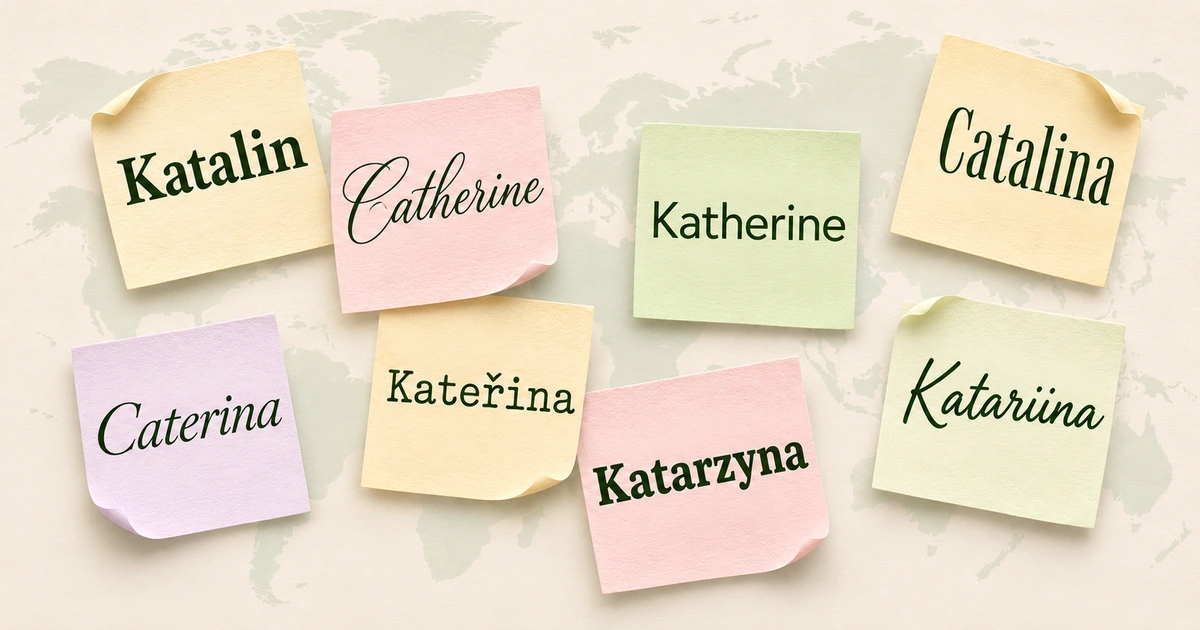
The familiar answer is “pure.” That meaning comes from a traditional association with the Greek adjective katharos. The older Greek given name, usually written Aikaterinē in English, has an uncertain etymology. Over time, people associated the name with a Greek word that sounded like it and gave it a meaning that made sense to them. That association is part of the name’s history and helps explain the th in familiar forms such as Catherine, Katherine and Katharina.
English acquired the name through medieval forms that circulated in Latin and French. Both Catherine and Katherine became established English spellings, and English later developed or adopted further forms such as Kathryn. The Hungarian Katalin belongs to the same family. The connection becomes easier to see when the two names sit alongside Italian Caterina, Spanish Catalina and Slovak Katarína.
The name’s spread also owes much to the medieval popularity of Saint Catherine of Alexandria. Her story travelled through churches, books and images. As the name became familiar across Europe, communities fitted it to their own languages. Some of the results still look close to the English spellings. Others, such as Polish Katarzyna or Estonian Kadri, may surprise an English speaker encountering them for the first time.
The table includes full given names, spelling variants and familiar forms. A short form can become a given name in its own right, so someone called Kate, Kata or Kadri may have that exact name on their birth certificate. Languages are listed as examples of where a form is used. Several spellings cross national borders.
| Name | Language or usage | Relationship to Catherine |
|---|---|---|
| Catherine | English and French | A full form shared by both languages. |
| Katherine | English | An established spelling with an initial K. |
| Katharine | English | The spelling used by Katharine Hepburn. |
| Kathryn | English | A full spelling variant with a compressed ending. |
| Kate | English | A short form of Catherine or Katherine. |
| Katie | English | A familiar form of Kate or Katherine. |
| Catrin | Welsh | A Welsh form of the name. |
| Catriona | Scottish Gaelic and English | Associated with the Scottish Gaelic form Catrìona. |
| Katharina | German | A full form with the ending -arina. |
| Kathrin | German | A shorter form related to Katharina. |
| Katalin | Hungarian | The full form traditionally celebrated on November 25 in Hungary. |
| Kata | Hungarian, among other languages | A short form of Katalin in Hungarian. |
| Caterina | Italian | The form used for Saint Catherine of Siena in Italian. |
| Catalina | Spanish | The form found in Catalina de Aragón. |
| Catarina | Portuguese | A Portuguese full form. |
| Kateřina | Czech | The Czech full form, written with ř. |
| Katarína | Slovak | The Slovak full form, written with í. |
| Katarzyna | Polish | The Polish full form. |
| Kasia | Polish | A familiar form of Katarzyna. |
| Aikaterini | Greek, in Latin transliteration | A rendering of the Greek name Αικατερίνη. |
| Ekaterina | Russian, in Latin transliteration | A rendering of Екатерина, also written Yekaterina. |
| Ecaterina | Romanian | The Romanian full form. |
| Katarina | Swedish, among other languages | A spelling listed in the Swedish name-day calendar. |
| Katariina | Finnish | A Finnish full form with a doubled i. |
| Kadri | Estonian | An Estonian form found in the name of the folk holiday Kadripäev. |
Some of the differences tell you how the name has been adapted to a language’s spelling. Compare Katarína, with its accented vowel, and Katariina, with its doubled vowel. The Polish pair Katarzyna and Kasia shows a different kind of change. A nickname can take on a shape of its own, just as Kate does in English. The Greek and Russian entries introduce another wrinkle. English-language sources can spell a name differently when they convert it from another alphabet, so you may see both Ekaterina and Yekaterina for the same Russian name.
November 25 is the date that links the examples below. A civil name-day list, a Catholic calendar and a folk calendar serve different purposes, even when they put related names on the same date. France and Estonia illustrate the difference especially well. The French entry refers to a saint in a church calendar, while the Estonian entry includes a named day in the folk calendar with customs of its own.
| Country | Local form | November 25 in the local calendar |
|---|---|---|
| Hungary | Katalin | The traditional Hungarian Katalin name day. |
| Czechia | Kateřina | Listed on November 25 in the Czech name-day calendar. |
| Slovakia | Katarína | Listed on November 25 in the Slovak calendar of meniny, or name days. |
| Poland | Katarzyna | A date for Katarzyna’s imieniny. Polish calendars also record other dates. |
| Sweden | Katarina | The date given by the Swedish Institute for Language and Folklore. |
| Finland | Katariina, among other forms | The Finnish-language calendar lists Katariina alongside several related names, including Kati and Katri. |
| Estonia | Kadri | The date of Kadripäev, Saint Catherine’s Day in the Estonian folk calendar. |
| France | Catherine | The French Catholic calendar commemorates Catherine of Alexandria. |
The table can also help when a name comes up in conversation in a form you don’t recognise. A Polish friend who introduces herself as Kasia may be listed under Katarzyna in a name-day calendar. A Hungarian friend who goes by Kata may look for Katalin. In Finland, several related forms are printed together on the same day, so you can find Kati and Katri alongside Katariina. The spelling you use in the greeting can still be the one your friend uses every day.
The saint behind the November date is Catherine of Alexandria, traditionally remembered as an early Christian martyr. In the story told about her, a spiked wheel was prepared to torture her and broke before it could kill her. That episode gave artists a way to identify her in a painting or sculpture. A wheel, sometimes shown broken, could tell viewers which Catherine they were looking at without a written caption.
The details belong to the legend that grew around the saint. Her place in the history of the name comes from the reach of that tradition. The story and feast travelled widely enough for related names to appear on the same date across countries whose inhabitants spoke very different languages. The wheel is the image readers may recognise first. The calendar date is the part of the tradition they can still find in everyday use.
April 29 is the Catholic feast of Catherine of Siena, a fourteenth-century Italian mystic and writer. She is remembered for her letters and for intervening in the religious affairs of her time. In Italian she is Caterina da Siena, another example of how English sources translate historical names into a form familiar to their readers.
The spring date belongs to Catherine of Siena, and the autumn date belongs to Catherine of Alexandria. A name-day list may include either or both dates, depending on the tradition it follows. If you’re choosing a date for a greeting, the calendar the recipient uses is a better guide than a search for a single worldwide Catherine name day.
One Hungarian saying compresses a whole winter forecast into five words: Ha Katalin kopog, karácsony locsog. A fairly literal translation is “If Catherine knocks, Christmas splashes.” The “knock” evokes a hard frost, while the “splash” suggests wet weather or a thaw. In everyday English, the forecast is that a frosty Saint Catherine’s Day will be followed by a wet Christmas. Folklore sources also record the reverse prediction, in which wet weather on Katalin Day points to a frosty Christmas.
November 25 falls a month before Christmas Day, which makes it an easy date to remember and compare with the holiday. The rhyme does the rest. Even in translation you can hear what the original does with sound. First comes the hard ground, then comes the splash. That makes it a good example of how a saint’s day could become a marker in the agricultural and domestic calendar.
In Salánk, a Hungarian-speaking community in what is now Ukraine, ethnographers also recorded a custom involving a cut branch. People brought it indoors and stood it in water so it might bloom by Christmas. The branch gave the household something to watch between the two dates. Details such as the type of branch and what its flowering meant are best understood as local traditions.
In France, a Catherinette was traditionally an unmarried woman who had reached the age of 25. On Saint Catherine’s Day, she could be the focus of a celebration that included a striking hat. Yellow and green are the colours most often associated with the custom. Its premise reflects older expectations about the age at which women should marry, while its most recognisable object gives us a glimpse into the working lives of the people who made the hats.
The tradition became particularly visible in Parisian fashion and millinery. A hat made for the occasion could be deliberately impractical and full of visual jokes. The workshop had a reason to put its skills on display, and the wearer had a hat made to attract attention. Photographs of the celebrations preserve a side of fashion history that formal portraits rarely show: the people behind the clothes making something for one another.
The Catherinettes custom and a greeting to someone named Catherine share a date and a saint. The women wearing the hats could have any first name. What made them Catherinettes was their place in the custom, which explains why the name survives in French cultural history beyond the ordinary list of name days.
In Estonia, Kadripäev takes its name from Kadri and falls on November 25. One of its best-known customs involved groups of disguised visitors going from house to house. Light-coloured clothing is associated with their costumes. Visitors might sing or speak ritual greetings and offer the household wishes for good fortune. In return, the hosts could give them food or other treats.
The wishes often concerned the household’s wellbeing and livestock. They made sense at a time of year when families were entering winter and the health of their animals mattered to the months ahead. A house visit gave neighbours a way to express those hopes aloud. The custom also made room for performance, disguise and humour.
The Estonian folk calendar places Kadripäev alongside another November visiting tradition, Mardipäev, or Martin’s Day. The two dates show how a community could build several recognisable occasions around the turn of the season. For the visitor who comes across the name Kadri on November 25, the local word opens a window into that wider calendar.
The youngest surviving daughter of Isabella of Castile and Ferdinand of Aragon appears in English history as Catherine of Aragon. In Spanish she is Catalina de Aragón. She first married Arthur, Prince of Wales, and later his brother Henry VIII. Her daughter became Mary I of England. The two versions of her name put the table of variants into a real historical setting. Searching for Catalina takes you into Spanish accounts of the same woman English readers usually meet as Catherine.
The future Russian empress was born Sophie of Anhalt-Zerbst. She took the name Ekaterina on converting to Russian Orthodoxy before her marriage to the future Peter III. As ruler, she became Catherine II in English and is widely known as Catherine the Great. Her case shows how a name could mark a major change in public identity. The English rendering conceals part of that story until you encounter the Russian form and ask how she came to bear it.
The American actor’s first name is Katharine, with an a after the th. It is easy to miss if you are more used to seeing Katherine. Hepburn’s films include The Philadelphia Story and The African Queen. She won four Academy Awards for acting. Her screen credits offer a familiar example of why the variants matter in practice. Two spellings may belong to the same name family, but only one belongs on a particular person’s name.
Katalin Karikó shared the 2023 Nobel Prize in Physiology or Medicine with Drew Weissman. Their discoveries concerning modifications to messenger RNA helped enable the development of effective mRNA vaccines against COVID-19. The Nobel Prize records her name as Katalin. English-language history often calls Catalina of Aragon “Catherine,” while English-language reporting on Karikó uses her Hungarian given name. That is how many readers around the world have come to recognise the spelling they would see in a Hungarian calendar on November 25.
Yes. Katalin is the Hungarian form of Catherine and Katherine. It belongs to the same name family as Italian Caterina, Spanish Catalina, Czech Kateřina and Polish Katarzyna. Kata is a familiar Hungarian short form of Katalin.
Catherine is traditionally associated with the meaning “pure,” from Greek katharos. The older Greek name Aikaterinē has an uncertain etymology, so “pure” is best described as the traditional interpretation.
November 25 is the traditional name day for Katalin in Hungary. It coincides with the feast of Saint Catherine of Alexandria and is the date behind the Hungarian saying about Katalin Day and Christmas weather.
The dates honour two different saints. November 25 commemorates Saint Catherine of Alexandria, remembered in the legend of the wheel. April 29 commemorates Saint Catherine of Siena, a fourteenth-century Italian mystic and writer.