
2026. november 9., hétfő
Tivadar névnapja
Tivadar névnapja
In France, Élisabeth is traditionally celebrated on November 17. In Hungary, Erzsébet's principal name day is November 19. Germany, Sweden, Poland and several other European countries also recognize November 19, while some calendars include additional dates. So why does one name have so many forms, and why do its celebrations differ?
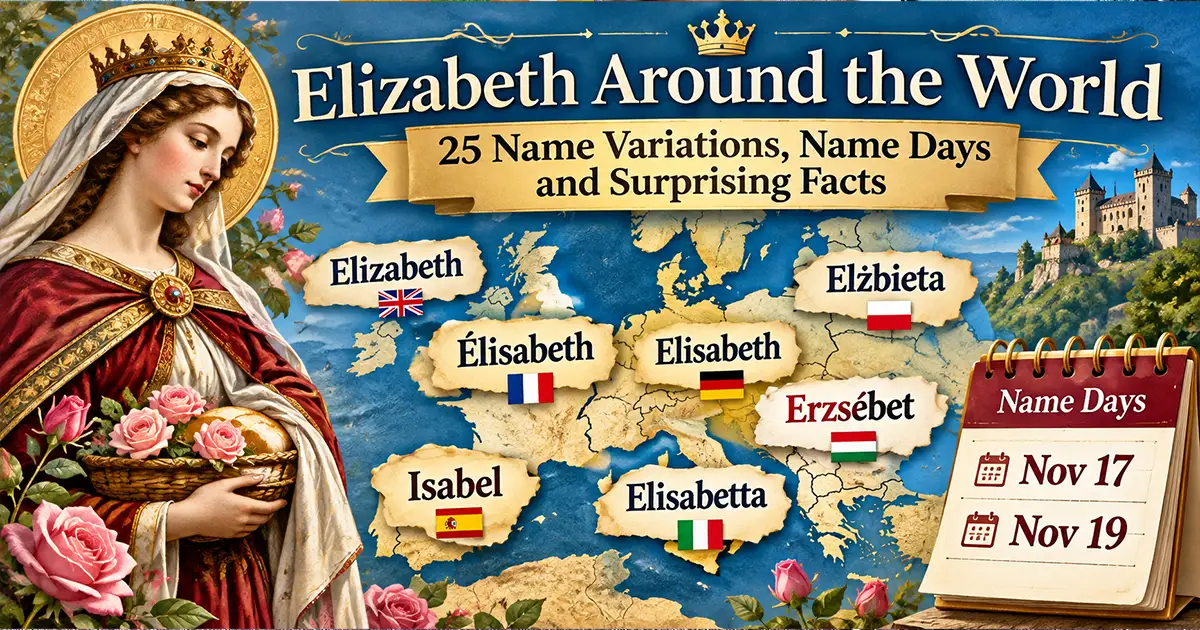
The name Elizabeth has a history that begins long before the modern European languages existed. Its roots can be traced to the Hebrew name Elisheva, usually interpreted as "God is my oath" or "My God is an oath."
The name entered Greek as Elisabet and subsequently spread through Latin biblical and Christian traditions. Over centuries, it developed into numerous regional forms, each influenced by local pronunciation, spelling and language history.
One of the best-known biblical Elizabeths appears in the Gospel of Luke. She was the wife of Zechariah and the mother of John the Baptist. According to the biblical account, she was a relative of Mary, the mother of Jesus.
This religious connection helped the name spread across Christian Europe. Later, queens, princesses and saints reinforced its popularity, making Elizabeth both a traditional religious name and a symbol of royalty.
Few traditional names have travelled across languages as successfully as Elizabeth. Some versions differ by only one letter, while others look almost unrelated at first glance.
The English Elizabeth and German Elisabeth are immediately recognizable as relatives. The Hungarian Erzsébet and Polish Elżbieta are more distinctive, while Spanish Isabel and Italian Isabella reflect a separate historical development of the same name.
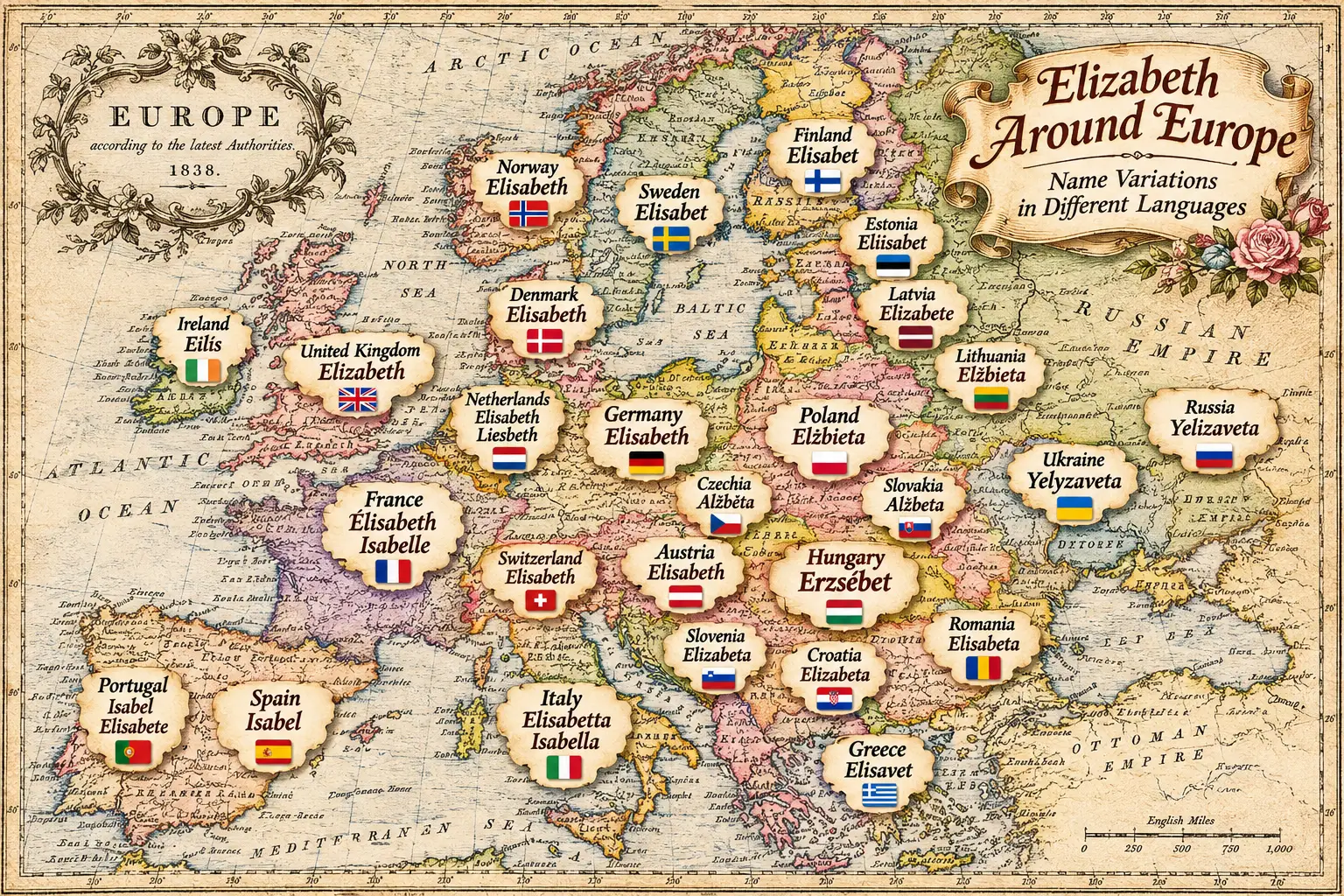
The following table presents 25 countries and languages, showing one or more commonly recognized forms. These are representative examples rather than exhaustive lists, and several forms are shared across national borders.
| Country | Language | Name variation |
|---|---|---|
| United Kingdom | English | Elizabeth |
| Germany | German | Elisabeth |
| France | French | Élisabeth, Isabelle |
| Hungary | Hungarian | Erzsébet |
| Poland | Polish | Elżbieta |
| Czechia | Czech | Alžběta |
| Slovakia | Slovak | Alžbeta |
| Italy | Italian | Elisabetta, Isabella |
| Spain | Spanish | Isabel |
| Portugal | Portuguese | Isabel, Elisabete |
| Sweden | Swedish | Elisabet |
| Finland | Finnish | Elisabet |
| Denmark | Danish | Elisabeth |
| Norway | Norwegian | Elisabeth |
| Netherlands | Dutch | Elisabeth, Liesbeth |
| Russia | Russian | Yelizaveta |
| Ukraine | Ukrainian | Yelyzaveta |
| Greece | Greek | Elisavet |
| Romania | Romanian | Elisabeta |
| Croatia | Croatian | Elizabeta |
| Slovenia | Slovenian | Elizabeta |
| Estonia | Estonian | Eliisabet |
| Latvia | Latvian | Elizabete |
| Lithuania | Lithuanian | Elžbieta |
| Ireland | Irish | Eilís |
One especially interesting example is the Hungarian Erzsébet. Its spelling differs considerably from Elizabeth, yet it has the same underlying origin. Similarly, Polish Elżbieta and Czech Alžběta demonstrate how a familiar biblical name can develop a distinct national identity.
Spanish Isabel and Portuguese Isabel illustrate another linguistic path. These forms became especially influential through royal families, historical figures and literature.
For a closer look at the Hungarian tradition, explore the meaning and name day of Erzsébet in Hungary. The page is available in Hungarian.
There is no single international Elizabeth name day. Unlike birthdays, name days are determined by national calendars, religious traditions and local customs.
In many European countries, November 19 is associated with Saint Elizabeth of Hungary, also known as Saint Elizabeth of Thuringia. However, the modern Roman Catholic liturgical calendar commemorates her on November 17.
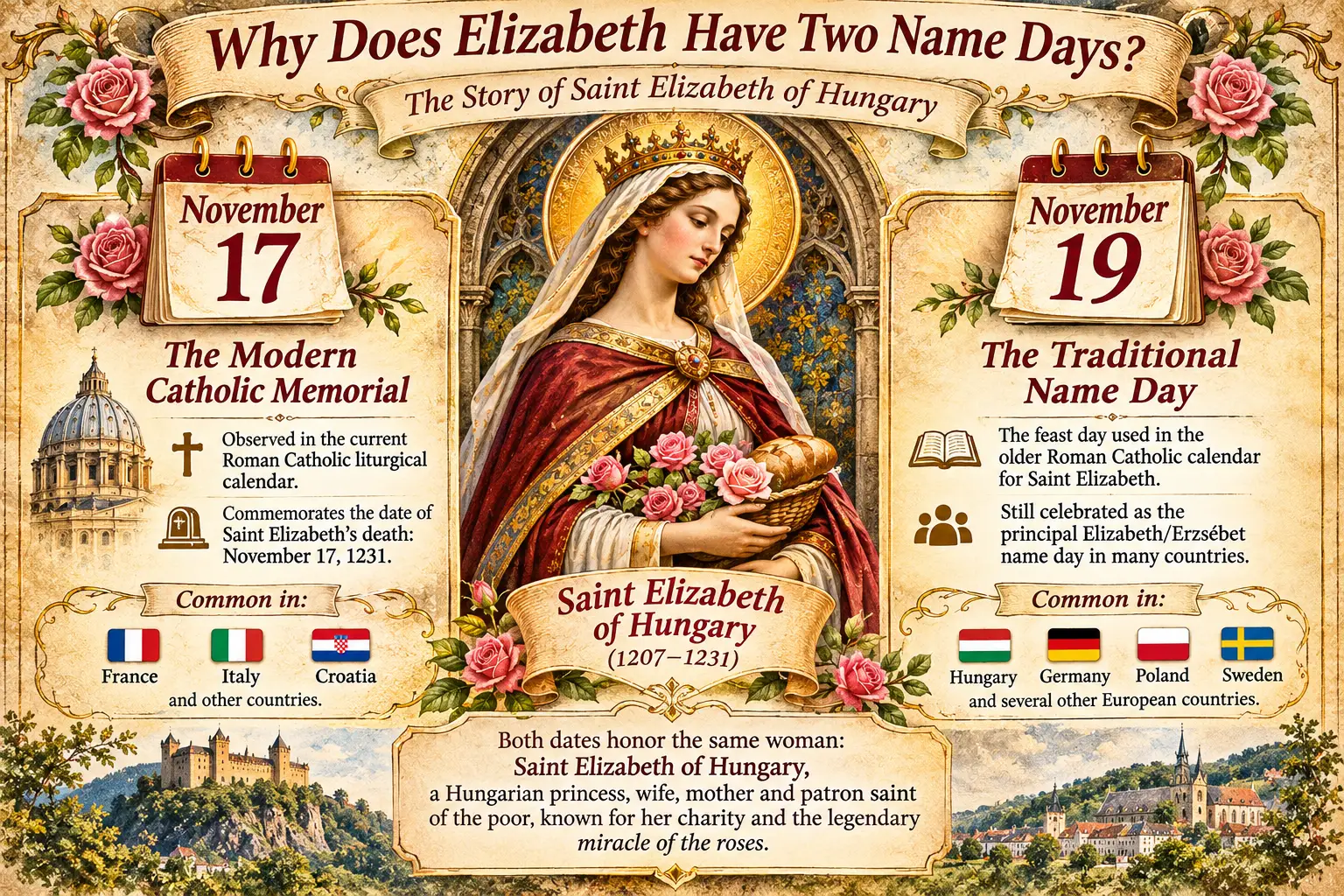
This difference explains why someone named Élisabeth in France may celebrate on November 17, while an Erzsébet in Hungary celebrates on November 19.
| Country | Name | Name day |
|---|---|---|
| France | Élisabeth | November 17 |
| Italy | Elisabetta | November 17 |
| Hungary | Erzsébet | November 19 |
| Germany | Elisabeth | November 19 |
| Austria | Elisabeth | June 18, July 4, November 19 |
| Poland | Elżbieta | November 19 and other dates |
| Czechia | Alžběta | November 19 |
| Slovakia | Alžbeta | November 19 |
| Sweden | Elisabet | November 19 |
| Finland | Elisabet | November 19 |
| Denmark | Elisabeth | November 19 |
| Norway | Elisabeth | November 19 |
| Estonia | Eliisabet | November 19 |
| Latvia | Elizabete | November 19 |
| Croatia | Elizabeta | November 17 |
| Spain | Isabel | November 17 in some calendars |
Note: The table shows selected dates recorded in national or widely used name-day calendars. Some countries recognize several dates for the same name, while religious feast days and civil name days may differ. Local calendars should be consulted when choosing a date for a particular person.
Austria offers a particularly good example of this complexity. Elisabeth can be associated with June 18, July 4 or November 19, depending on the saint and calendar tradition.
In Poland, Elżbieta also appears on multiple dates. This reflects the historical practice of connecting a name to different saints rather than assigning one universally accepted celebration.
At first glance, the difference seems puzzling. France celebrates Élisabeth on November 17, while Hungary traditionally celebrates Erzsébet on November 19. Yet both dates are closely associated with the same historical figure: Saint Elizabeth of Hungary.
Elizabeth was born into the Hungarian royal family in 1207 and later lived in Thuringia, in present-day Germany. She became famous for her charitable work and her devotion to people living in poverty.
She died on November 17, 1231, at just 24 years old. Her reputation for holiness spread quickly, and she was canonized in 1235.
In the older Roman Catholic calendar, her feast was observed on November 19. Following the twentieth-century reform of the General Roman Calendar, her memorial was placed on November 17, the anniversary of her death.
France follows the November 17 date in its modern Catholic tradition. Hungary, however, retains November 19 as the principal Erzsébet name day, reflecting the older historical tradition.
Many other European name-day calendars also preserve November 19, including those used in Germany, Sweden and Norway.
Importantly, the distinction is not simply between France and Hungary. It reflects the difference between a modern liturgical memorial and name-day traditions that developed independently in different countries.
For readers in the United Kingdom or the United States, the idea of celebrating a name day may be unfamiliar. In many European countries, however, it is a longstanding tradition.
A name day is a date associated with a person's given name, often originally linked to a Christian saint. Although the religious background remains important, modern celebrations can be entirely secular.
In Hungary, name days are widely recognized. Friends, relatives and colleagues may congratulate someone with flowers, a small gift, a message or a phone call.
For women named Erzsébet, November 19 is the principal celebration. Many families treat it as a pleasant occasion to gather or share a special meal.
The Hungarian expression "Boldog névnapot!" means "Happy name day!" and is commonly used in greetings.
In Poland, name days are known as imieniny. They have traditionally played an important role in social life, particularly among older generations.
People may receive flowers, chocolates or visits from relatives and friends. Some families organize gatherings, while others celebrate more informally.
For Elżbieta, November 19 is one recognized date, although Polish calendars also list other possibilities.
Sweden and Finland maintain strong traditions of recording given names in calendars. Even when celebrations are modest, name days remain a familiar cultural reference.
In Sweden, Elisabet shares November 19 with Lisbet. The official Swedish name calendar preserves a connection between this date and Saint Elizabeth of Thuringia.
Finland also recognizes Elisabet on November 19, although Finnish-language and Swedish-language calendars may differ in their treatment of related names.
In Germany and Austria, name days are known as Namenstag. Their importance varies considerably by region, family and religious background.
In some Catholic communities, a person's name day can be a meaningful occasion. Elsewhere, it may pass with little celebration.
In English-speaking countries, birthdays are generally much more important than name days. Most people named Elizabeth do not have one universally recognized national name-day date.
However, people with European family backgrounds or connections to particular Christian traditions may still observe a patron saint's feast day.
One of the most remarkable stories connected to the name Elizabeth begins in medieval Hungary.
Elizabeth was born in 1207, the daughter of King Andrew II of Hungary and Gertrude of Merania. As a young child, she was sent to the court of Thuringia, where she would eventually marry Louis IV, Landgrave of Thuringia.
Although she lived among the nobility, Elizabeth became known for her extraordinary concern for the poor and sick. She distributed food, supported people in need and devoted substantial resources to charitable activities.
After her husband's death in 1227, she increasingly dedicated her life to religious service and helping others. She died in Marburg in 1231 and was canonized only four years later.
According to a popular legend, Elizabeth was once carrying bread to people in need when she was questioned about what she had hidden in her cloak.
When she opened it, the bread had miraculously turned into roses.
The story became one of the most recognizable symbols associated with Saint Elizabeth. In paintings and sculptures, she is frequently depicted holding roses or carrying bread.
Historians distinguish this later devotional legend from the documented events of her life. Nevertheless, the story has remained an enduring expression of generosity and compassion.
Today, Saint Elizabeth is remembered across Europe, connecting Hungarian, German and wider Christian cultural history.
Readers interested in the Hungarian background can explore the story of Saint Elizabeth and the legend of the roses.
The name Elizabeth has been associated with powerful rulers, influential cultural figures and internationally recognized personalities for centuries. From the royal courts of England and Austria to the golden age of Hollywood, women named Elizabeth have left a remarkable mark on history.
Some became symbols of political power, others transformed popular culture, while fictional characters helped shape the way generations of readers imagined intelligence, independence and femininity. Here are five famous Elizabeths whose stories continue to fascinate the world.
Queen Elizabeth I was one of England's most influential monarchs. The daughter of King Henry VIII and Anne Boleyn, she became queen in 1558 after a turbulent childhood marked by political uncertainty and religious conflict. Her 44-year reign, often called the Elizabethan era, brought greater political stability and helped establish England as an increasingly important European power. She never married, earning the famous nickname "the Virgin Queen," and used her unmarried status as a powerful element of her political identity.
Her reign witnessed a remarkable flowering of English literature and theatre. William Shakespeare, Christopher Marlowe and other writers helped create a cultural legacy that remains influential today. Elizabeth also supported maritime exploration and overseas trade, while England's defeat of the Spanish Armada in 1588 became one of the defining events of her reign. However, her rule was also marked by religious persecution, political conspiracies and difficult relations with neighboring powers.
Elizabeth I carefully cultivated her public image through elaborate portraits, magnificent clothing and powerful royal symbolism. She often presented herself as a ruler devoted entirely to her country. Her intelligence, political determination and extraordinary longevity on the throne made her one of the most recognizable figures in British history. More than four centuries after her death, her name remains closely associated with the cultural achievements and political ambitions of Elizabethan England.
Queen Elizabeth II was born Elizabeth Alexandra Mary Windsor on April 21, 1926. She was not originally expected to become queen, but the abdication of her uncle, King Edward VIII, in 1936 changed the line of succession. When her father, King George VI, died in February 1952, the 25-year-old Elizabeth became monarch. Her coronation took place at Westminster Abbey on June 2, 1953, and became a landmark television event watched by millions of people.
During her reign, Elizabeth II witnessed enormous changes in Britain and around the world. She served through the governments of 15 British prime ministers, from Winston Churchill to Liz Truss, and saw the transformation of the British Empire into the modern Commonwealth. Technological advances, social changes and major political events reshaped the monarchy's role in public life. Despite periods of controversy surrounding the royal family, she remained a central figure in British national identity for seven decades.
Elizabeth II died on September 8, 2022, at Balmoral Castle in Scotland, aged 96. Having reigned for more than 70 years, she became the longest-reigning monarch in British history and one of the longest-reigning sovereigns in recorded history. Her image appeared on coins, banknotes and postage stamps across numerous countries, making her one of the most recognizable women of the twentieth and twenty-first centuries. Her life gave the name Elizabeth an enduring association with duty, continuity and public service.
Elizabeth Taylor was one of the greatest stars of Hollywood's golden age. Born in London in 1932 to American parents, she moved to the United States as a child and began her film career at an early age. Her breakthrough came with the 1944 film National Velvet, in which she played a young girl determined to succeed in horse racing. As she grew older, Taylor developed from a popular child actress into one of the most admired performers of her generation.
Her acting career included unforgettable performances in films such as A Place in the Sun (1951), Giant (1956), Cat on a Hot Tin Roof (1958) and Cleopatra (1963). She won two Academy Awards for Best Actress, for BUtterfield 8 (1960) and Who's Afraid of Virginia Woolf? (1966). Her striking violet-appearing eyes, glamorous appearance and highly publicized personal life attracted enormous media attention. Her relationship and marriages with actor Richard Burton became especially famous.
Beyond her film career, Elizabeth Taylor became an important humanitarian figure. During the AIDS crisis of the 1980s, when the disease was surrounded by fear and stigma, she publicly supported people affected by HIV/AIDS and helped raise awareness and funding for research and care. She co-founded the American Foundation for AIDS Research (amfAR) and later established the Elizabeth Taylor AIDS Foundation. Her legacy therefore extends far beyond Hollywood glamour: she is remembered both as an exceptional actress and as a committed advocate for humanitarian causes.
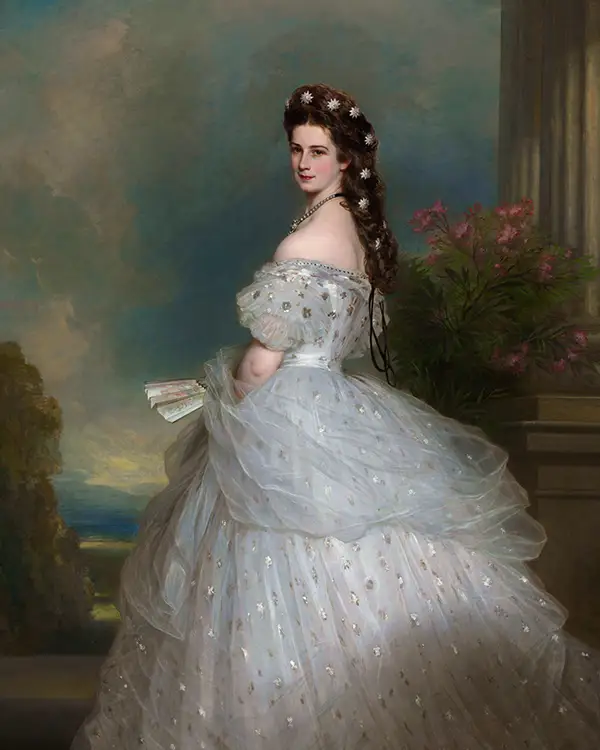
Empress Elisabeth of Austria, widely known as Sisi, was born Elisabeth Amalie Eugenie in Munich on December 24, 1837. She belonged to the Bavarian royal House of Wittelsbach and grew up in a relatively informal family environment. Her life changed dramatically when Emperor Franz Joseph I of Austria fell in love with her during a family meeting in 1853. They married in Vienna in 1854, when Elisabeth was only 16 years old. The young empress soon discovered that the strict rules and ceremonial expectations of the Habsburg court were very different from the freedom she had enjoyed during her childhood.
Elisabeth became famous for her beauty, extraordinarily long hair and elaborate beauty routines. She devoted considerable attention to physical exercise, horseback riding and maintaining her appearance. However, behind her glamorous public image was a woman who struggled with the restrictions of court life and experienced profound personal tragedies. The death of her young daughter Sophie in 1857 and the death of her only son, Crown Prince Rudolf, at Mayerling in 1889 deeply affected her. She increasingly sought privacy through extensive travel and withdrew from many official court activities.
Her relationship with Hungary was particularly significant. Elisabeth developed a strong affection for Hungarian culture, learned the Hungarian language and supported reconciliation between the Austrian monarchy and Hungarian political leaders. She was crowned Queen of Hungary alongside Franz Joseph in Budapest in 1867, following the Austro-Hungarian Compromise. Her popularity among Hungarians remained strong long after her assassination in Geneva in 1898. Today, she is commemorated in monuments, street names and landmarks, including Budapest's Elisabeth Bridge (Erzsébet híd). Her story also inspired numerous films, books and musicals, making Sisi one of Europe's most enduring royal legends.
Not every famous Elizabeth was a historical person. Elizabeth Bennet, the heroine of Jane Austen's novel Pride and Prejudice, is one of the most beloved fictional characters in English literature. First published in 1813, the novel follows the lives of the Bennet family in rural England, focusing particularly on questions of marriage, social class, reputation and personal judgment. Elizabeth, affectionately called Lizzy by her family, is the second of five daughters and stands out for her lively intelligence, sharp wit and independent personality.
Unlike many young women in her social environment, Elizabeth refuses to consider marriage merely as a way to secure financial stability. Her complicated relationship with the wealthy and initially proud Mr. Fitzwilliam Darcy forms the emotional center of the novel. Their misunderstandings, changing opinions and gradual recognition of each other's qualities make Pride and Prejudice one of literature's most enduring romantic stories. Elizabeth's willingness to challenge social expectations, combined with her capacity to recognize her own mistakes, gives her character unusual depth.
More than two centuries after the novel's publication, Elizabeth Bennet remains a symbol of intelligence, humor and personal independence. She has been portrayed in numerous film and television adaptations, including the acclaimed 1995 BBC series starring Jennifer Ehle and the 2005 film featuring Keira Knightley. Her influence extends beyond literature into modern popular culture, where she is frequently celebrated as one of the most memorable female characters ever created. Through Elizabeth Bennet, the name Elizabeth became associated not only with royalty and historical power but also with wit, courage and the determination to make one's own choices.
From Erzsébet in Hungary to Yelizaveta in Russia, Elizabeth has adapted to the sounds and spelling systems of many languages. Some variations preserve almost the entire original form, while others have changed dramatically over centuries.
These differences reveal how names travel with religion, migration, royal marriages and cultural exchange. A name that began in ancient Hebrew became a familiar part of European naming traditions.
Today, Elizabeth is an excellent example of how one historical name can acquire many national identities without losing its common origin.
At first glance, Elizabeth and Isabella might seem like completely separate names. In fact, they belong to the same historical family.
Forms such as Isabel developed through medieval Romance-language traditions and became especially popular in Spain and Portugal. Isabella subsequently gained widespread recognition in Italy and English-speaking countries.
Although the names share an origin, their modern usage can be quite different. Their name days, popularity and cultural associations depend on the country and calendar.
November 17 and November 19 both have strong connections to Saint Elizabeth of Hungary. The former is the date of her death and her modern Roman Catholic memorial, while the latter reflects an older liturgical tradition preserved in numerous national name-day calendars.
This is why the French Élisabeth and Hungarian Erzsébet can have different principal name days even though both are connected to the same saint.
The difference is a reminder that name-day calendars are cultural and historical documents, not simply universal lists of birthdays for names.
The name Elizabeth appears repeatedly in European royal history. It has been carried by queens, princesses and empresses across different countries and centuries.
In Britain, Elizabeth I and Elizabeth II are particularly famous. In Central Europe, Empress Elisabeth of Austria remains an iconic figure, especially in Hungary.
Royal connections helped strengthen the name's reputation for elegance and tradition. However, Elizabeth was never exclusively aristocratic: it also became an ordinary and widely used name among the general population.
Hungarian Erzsébet looks noticeably different from English Elizabeth. Yet both names can be traced to the same biblical origin.
The Hungarian form developed through the historical evolution of the language and has been used for centuries. Its association with Saint Elizabeth of Hungary gave it particular cultural significance.
In Hungary, the name also appears in place names, institutions, monuments and historical references. One well-known example is the Elisabeth Bridge in Budapest, named after Empress Elisabeth of Austria.
Elizabeth is unusually versatile when it comes to short forms. English speakers may use Liz, Lizzie, Beth, Betty, Betsy, Ellie or Eliza.
Other languages have developed their own affectionate forms. Hungarian includes Erzsi, Bözsi and Zsóka, while Polish speakers may use Ela or Elżunia.
Some nicknames have become independent given names in their own right. Lisa, for example, originated as a short form of Elisabeth but is now widely recognized as a separate name.
For people unfamiliar with the tradition, name days may sound like an unusual custom. But in parts of Europe, they have been an important feature of family and community life for generations.
In Hungary, a person named Erzsébet may receive flowers and greetings on November 19. In Poland, a woman named Elżbieta may celebrate her imieniny with friends and family.
The exact traditions vary, but the central idea is similar: a name is more than a personal label. It can also connect people to shared history, language and cultural identity.
The international history of Elizabeth combines language, religion and cultural traditions. The following table summarizes the most important facts.
| Topic | Key fact |
|---|---|
| Original name | Elisheva (Hebrew) |
| Traditional meaning | God is my oath |
| English form | Elizabeth |
| German form | Elisabeth |
| Hungarian form | Erzsébet |
| Polish form | Elżbieta |
| Spanish form | Isabel |
| Italian forms | Elisabetta, Isabella |
| Major European name day | November 19 |
| French Élisabeth name day | November 17 |
| Modern Catholic memorial | November 17 |
| Historical saint | Saint Elizabeth of Hungary |
| Famous legend | The miracle of the roses |
| Popular nicknames | Liz, Beth, Betty, Ellie, Erzsi, Ela |
There is no single worldwide date. November 19 is an important Elizabeth name day in Hungary, Germany, Sweden, Poland and several other European countries. In France, Élisabeth is commonly celebrated on November 17. Other dates may also appear in national or religious calendars.
Yes. Elisabeth and Elizabeth are spelling variations of the same name, ultimately derived from the Hebrew Elisheva. Elisabeth is especially common in several continental European languages, while Elizabeth is the familiar English spelling.
France generally recognizes November 17, the modern Catholic memorial of Saint Elizabeth of Hungary. Hungary traditionally celebrates Erzsébet on November 19, a date preserved from the older liturgical calendar.
Elizabeth comes from the Hebrew name Elisheva, traditionally interpreted as "God is my oath" or "My God is an oath." The name has a long biblical history and numerous international variations.
Elizabeth is much more than a familiar English name. From the Hungarian Erzsébet to the Polish Elżbieta, the French Élisabeth and the Spanish Isabel, its international variations tell a story of language, faith, royalty and cultural exchange.
The differences between November 17 and November 19 show how historical traditions can shape something as personal as a name day. Even when the dates vary, the connection to Saint Elizabeth of Hungary remains an important part of the name's European heritage.
Whether you are celebrating Elizabeth, Elisabeth, Erzsébet, Elisabet or Elżbieta, the name carries a remarkable history shared by millions of people across generations.
Happy name day to every Elizabeth around the world!
